

 Jeung San Do Terms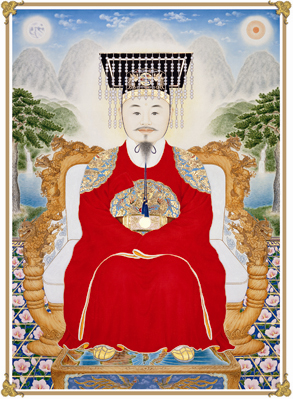
It is a truth both mysterious and revelatory-both astonishing and yet so intuitively correct-that the great religions of our world all worship the same supreme spiritual being: Sangjenim, God the Ruler. Christianity worships Sangjenim as ‘God the Father’; Buddhism knows Him as ‘Maitreya Buddha, the Lord of Tushita Heaven’; while Daoism and Confucianism know Him as ‘Sangje’ or ‘Okhwang-Sangje’ (“Jade Emperor of Heaven”).There came a time when an assembly of the spirits of all sages, buddhas, and bodhisattvas appeared before Sangjenim’s throne in heaven and entreated Him to save humanity and spirits. Heaven and earth, humanity, and spirits had all fallen into a malaise from which they could find no deliverance, and the epochal transition from the cosmic age of the Early Heaven to the age of the Later Heaven was approaching. At this time of transition, known as gaebyeok, humanity faced extinction from the disasters of war and disease and from upheavals in the natural world. In answer to this assembly’s pleas, Sangjenim resolved to personally incarnate into this world.
In the darkest hour of the night of September 19, 1871, God incarnated into the earth as Gang Jeung-san, the son of a humble farming family in a small Korean village, Gaengmang-ri.
Even during His childhood, Sangjenim’s divine nature was apparent to those around Him. Yet, despite the peerless brilliance that He displayed from childhood, Sangjenim lived His early life in extreme poverty and hardship, toiling as a farmhand and as a woodcutter.
Embracing both the joys and sorrows of human life, Sangjenim wandered the land as a young man. Observing the corruption and decay and misery and strife that beset all humans, He resolved to save the world, yet: “He concluded in 1901 that the grand tides of change made it impossible to deliver the world by any known methods or means” (Dojeon 2:1:2).
In preparation for His grand struggle to redeem humankind, Sangjenim entered into a vigil of meditation in 1901. Meditating for fourteen days on Sirusan Mountain and for twenty-one days on Moaksan Mountain, He attained ultimate enlightenment by opening the great gate of the spirit world. With this enlightenment, Sangjenim resumed His boundless authority over the three realms of heaven, earth, and humanity, which He had exercised in heaven before assuming His human body.
Clad in His divine nature, Sangjenim performed countless miracles-commanding the weather, summoning spirits, traveling the countries of the world, journeying into the depths of the sea, even demonstrating the power to stop the rising of the sun. Foremost, however, Sangjenim was a healer who offered comfort, cured disease, and even raised the dead-often with only His voice or a flick of His finger.
For all His renown as a healer of mortals, Sangjenim nevertheless had incarnated on earth for the purpose of an infinitely greater act of healing: the renewal of all of heaven and earth themselves. This was His grand labor of Cheonjigongsa. Sangjenim undertook this unprecedented work of renewing heaven and earth in order to save humanity and the spirits from the malaise that had sickened all of existence. Sangjenim performed Cheonjigongsa, His supreme work of renewing heaven and earth, for nine years.
Eventually, however, Sangjenim announced that His work on earth was complete and that He needed to return to heaven to continue Cheonjigongsa.